 |
 |
Scott MacLeod’s The Sacred Feminine and Masculine: Labyrinthina show deals with the sacred and spiritual. While the sources may be ancient, as is the dual yin-yang nature of masculine and feminine MacLeod captures, the exhibition functions as a total environment. Multi-media effects include video projection, and digitally manipulated photographs of men and women reflect the stages of life from birth to old age. MacLeod reinvigorates our interest in the symbolic sources for our own culture, long buried for many. Inadvertently we are reminded of how our culture has lost its sources, may not understand the sacred signs and symbols. As the paintings, photo-works, and videos in this show suggest, our belief systems are rooted in the world around us the cosmos and nature.
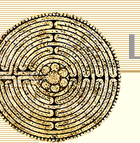
Video projections of wave and water patterns could reference the ancient belief that all life has its origins in water (and it does), while labyrinth and mandala symbols reference ancient views of the life process. A yin-yang symbol references the animus-anima duality of our unconscious thought processes. As Carl Jung has written:
“Though the effects of anima and animus can be made conscious, they themselves are factors transcending consciousness and beyond the reach of perception and volition.” 1
A ceiling projection of the Big Dipper at night, from which the yin-yang originally derived, in part due to its prominence in the night sky, again draws allusions to the way our cosmology is based in the real world, and responses over generations and centuries to these effects. And so ultimately, MacLeod’s Sacred Feminine and Masculine, is a homage to our place in the universe, which may be precarious, as our ancestors were quite aware of.
On either side, placed in the upper sections of the walls, we see elongated ships that suggest a great journey or the voyage of life itself. Ships are likewise symbolic of emigration, and of a mid point between home and away. The images recall the journey of life, how life builds upon life, seizes life only to dissolve before new lives come into being. The life cycle is represented in a variety of ways throughout this exhibition. We see two sets of seven vertical digitally manipulated photographs transferred to canvas of men and of women. They are presented at various stages of life from childhood to old age, and integrated within each tableau above and below are symbols that indicate the cycle of life and death; an oak leaf, a maple seedling, the ancient sacred geometry, a raven, a dragonfly, a butterfly.
Seen as a whole Scott MacLeod’s presentation combines aspects of human and natural history (of which we are a part). As a totality, the piece is conceived like a hagiography or theatre dedicated to life. The exhibition is a site that reifies a cosmic vision of the world, with natural and human references. We live in a world where our memory of the past is ironically vanishing at the same time as we have advanced information and data storage systems. This presentation has sources that are ancient, reflect our collective origins, the way our various tribal and geo-specific identities all draw on unconscious stimuli that links and builds its meaning with reference to nature. While the techniques and multi-media approach Scott MacLeod uses are wholly contemporary, this environment is about our origins and the fragile and ongoing process of life, its mystery, the impossibility of decoding or explaining it entirely.
Footnote
1. C. G. Jung, Aspects of the Masculine / Aspects of the Feminine, trans.
R.F.C. Hull, MJF Books, New York, p. 177.
|
|
 |
 |